If you’ve just started racing on the iRacing platform, we can almost hear you asking the same question many new users have: “What is this Safety Rating?” If you’re looking for the answer to that question, you’ve come to the right place. In this comprehensive guide, we will provide clear and understandable answers to all your questions about Safety Rating (SR), which is essentially your virtual license in iRacing.
Rating Systems in iRacing
iRacing uses three primary rating systems to measure the skill and experience of its drivers:
- Safety Rating (SR): Your safety score, which measures how cleanly and incident-free your driving is on track. This is the main topic of this article.
- iRating (iR): Your skill rating, determined by your finishing positions in races, indicating your level of talent and speed.
- TT Rating (TTR): Your performance rating in Time Trial sessions.
In short, Safety Rating shows how safe and clean a driver you are, while iRating shows how fast you are.
Safety Rating (SR) License Levels
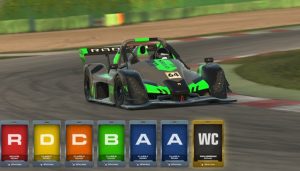
iRacing uses a license system that categorizes drivers into different classes based on their driving cleanliness. This system consists of a standard progression path and a special elite level:

Standard License Progression:
Rookie -> D -> C -> B -> A
- Rookie: The basic level where every user begins.
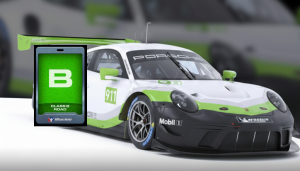
- A-Class: The highest license level achievable through standard progression. Drivers with this license are among the most experienced and typically the cleanest on the platform.
Special Elite License:
- Pro / WC: This level is not part of the standard progression path. The Pro license is a special status granted only to elite esports drivers who qualify for iRacing‘s most prestigious World Championship series. This level is achieved not through Safety Rating, but entirely through competitive success and a very high iRating score.
As a general rule, a driver with a Rookie license is assumed to be less experienced and more prone to making mistakes or causing accidents than a driver with an A-Class license.
Why Should You Increase Your Safety Rating?
Improving your SR level is vital for your iRacing experience. Here’s why:
- Higher Quality Races: A higher SR level matches you with drivers who are also focused on clean racing. This means fewer accidents and more enjoyable, competitive races.
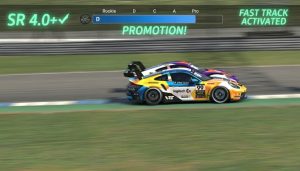
- New Series and Cars: Many race series and high-performance cars in iRacing require a specific license level. For example, to race GT3 cars, you often need a C or B-Class license. You cannot participate in these series without promoting your license.
How to Increase Safety Rating (and How Not to Lose It)
At this point, the best approach is to learn “how not to lose it.” This is because when you don’t lose Safety Rating, you will naturally start to gain it. The basic logic is this: every corner you complete without an incident earns you a small amount of Safety Rating.
However, keep in mind that if yellow flags are waving on the track, the corners in that sector will not earn you any points.
The key to increasing SR is to avoid accumulating “Incident Points.” The amount of SR you gain or lose at the end of a session is directly tied to the incident points you collected during that session.
What are Incident Points?
Incident points are penalties you receive for mistakes made on track. The lower your incident points, the higher your SR gain will be at the end of the session.
- 0x (Light Contact): Very light contact with another car that doesn’t cause a slowdown. It generally doesn’t affect SR but is recorded by the system.
- 1x (Off-Track): More than half of your car goes beyond the track limits defined by the white lines.
- 2x (Loss of Control): Losing control of your car, resulting in a spin or slide.
- 2x (Contact): Moderate contact with barriers, objects, or another car.
- 4x (Heavy Contact): Serious contact and collisions with another car or a barrier.
Important Note: If you commit multiple infractions in a single event, you will only receive the points for the most severe one. For example, if you spin (2x) and hit another car (4x), you will receive a total of 4x for that incident.
Different Disciplines, Different Safety Ratings
Yes, your Safety Rating is calculated separately for each type of racing. iRacing has four main racing disciplines, and each has its own SR and iR value:
- Road: The discipline featuring sports cars (GT3, GT4), open-wheel (Formula) cars, and prototypes.
- Oval: Encompasses racing on oval tracks, popular mainly in the United States (NASCAR, etc.).
- Dirt Road: Involves racing on mixed-surface tracks of dirt and asphalt, like Rallycross.
- Dirt Oval: Features racing on dirt-surfaced oval tracks.
This means your A-Class license in the “Road” category does not affect your Rookie license in the “Oval” category. You must progress separately in each discipline.
How Does the Safety Rating Formula Work?
While iRacing does not publicly disclose the exact Safety Rating formula, its principle of operation is well-understood. The system is based not on simple addition or subtraction but on an average called “Corners Per Incident” (CPI).
Here is the basic logic of how the formula works:
- CPI Average: The system maintains a running CPI average based on your performance in your recent sessions. This average indicates how clean of a driver you are.
- End-of-Session Calculation: After every official session (Practice, Qualifying, Race) is completed, your performance in that session affects your overall CPI average.
- Gain and Loss:
- If your CPI value from your last session is better than your overall average (meaning you made fewer mistakes), your Safety Rating will increase.
- If your CPI value from your last session is worse than your overall average (you made more mistakes), your Safety Rating will decrease.
In summary: make fewer mistakes, take corners cleanly, and stay away from accidents. Your Safety Rating will steadily increase over time. Good luck on the track!